
Lumpkin County Active Warrants Explained
An active warrant is simply an order a court has not yet served, recalled, or closed. Its true status lives with the record holder. In Lumpkin County, courts issue warrants. The Sheriff's Office serves many of them. Those roles overlap, but one office's file is never the whole picture, because the Enotah Judicial Circuit Superior Court, Lumpkin County Magistrate Court, Dahlonega Municipal Court, and Probate Court can each hold papers tied to matters within their own jurisdiction. For direct contact, the Lumpkin County Sheriff's Office page lists its address, main phone, dispatch number, and several public links. What it does not list is warrants. There is no searchable active-warrant roster, no downloadable list, no warrant portal, and no dedicated extension. Georgia's courts offer no statewide warrant search either. The state itself points people back to the local sheriff. That makes a direct call to Lumpkin County the right first step.
No Lumpkin County Warrant Table Exists
Lumpkin County posts no active-warrant table anywhere. There is no spreadsheet, no PDF roster, no Most Wanted page, and no published update schedule or correction process. That gap trips people up. The Sheriff's Inmate Check tool covers custody only. Treat it as a custody check, never as a warrant search, since someone can be out of custody while an order sits unserved, and someone in custody may have been booked for reasons a custody page never explains.
Myth: A missing online name means there is no warrant.
Fact: Lumpkin County has no official public warrant list, and no website result replaces a current Sheriff or issuing-court inquiry.
Dahlonega takes the same approach, publishing court and police guidance rather than a Lumpkin County warrant roster. Its EZ Court Pay tool looks up citations and payments. An empty result there proves nothing about any city, county, state, or federal warrant.
How Lumpkin County Tracks Active Warrants
No public list exists to walk through. A warrant's paper trail crosses offices. The court file may hold the issuing record plus later docket activity, while a Sheriff file may show receipt, attempted service, execution, or related enforcement steps. Georgia retention guidance even allows an original arrest warrant to move with the case into the trial-court file. So Lumpkin County's Magistrate, Sheriff, and Superior Court records can each reflect a different stage of one matter. For a current answer, call the Sheriff's Office at 706-864-0414 or non-emergency dispatch at 706-864-3633. Ask which unit handles warrant questions. Know the issuing court? Contact its clerk as well. Offices here do not sync every new, served, recalled, or transferred entry at the same moment.
Note: No public update cadence exists, so an old document or missing website entry never guarantees that a Lumpkin County warrant is inactive.
Lumpkin County Warrant Status Routes
Which route helps depends on where the order came from. Say the warrant type or case setting when you call. Say whether you want a live status answer or a copy of the record. The Lumpkin County offices are separate, even though several sit close together in Dahlonega.
Sheriff’s Office
Current county status routing or Sheriff-held service records.
706-864-0414
Magistrate Court
Local warrant applications and Magistrate issuance records.
706-864-7760
Superior Court Clerk
Enotah Superior Court criminal files and transferred records.
706-864-3736
Dahlonega Municipal Court
City traffic, ordinance, and misdemeanor court matters.
706-482-2720
Probate Court
County traffic-citation payment and appearance questions.
706-864-3847
GCIC and NCIC are law-enforcement systems, not public databases. A Lumpkin County inquiry cannot certify federal status. Federal matters run through the Northern District of Georgia and its public dockets.
Inside an Active Warrant Record
Lumpkin County publishes no sample warrant result. So no field list can be promised. Process and state retention rules do suggest what to ask the record holder to verify, though some details may be sealed, restricted, redacted, or held by another office.
| Warrant or case number | A locator if assigned and released; no public local format was found. |
|---|---|
| Issuing court | The authority over the order and the next case step. |
| Warrant type | Arrest, search, bench, failure to appear, municipal, traffic-related, or another confirmed term. |
| Issue date | The issuance date, which alone does not prove present status. |
| Reason or statute | The alleged basis when releasable, never proof of guilt. |
| Service or return | Agency action and dates when maintained and open. |
| Bond or conditions | Current terms only when the court, jail, or counsel confirms them. |
| Status | Active, served, recalled, transferred, or another term defined by the custodian. |
A blank status or missing return means nothing by itself. Ask the Lumpkin County clerk what the entry actually says and the date through which it is current.
507 Lumpkin County Warrant Calls
Call logs offer context without exposing case details. The Sheriff's 2024 Annual Statistical Report counted 507 calls coded "Warrant" and five coded "Search Warrant." The 2023 report logged 409 and twelve. Those are logged events in Lumpkin County, not tallies of unique orders, people, arrests, or active warrants.
The county’s official statistical report index organizes its annual and monthly reports.
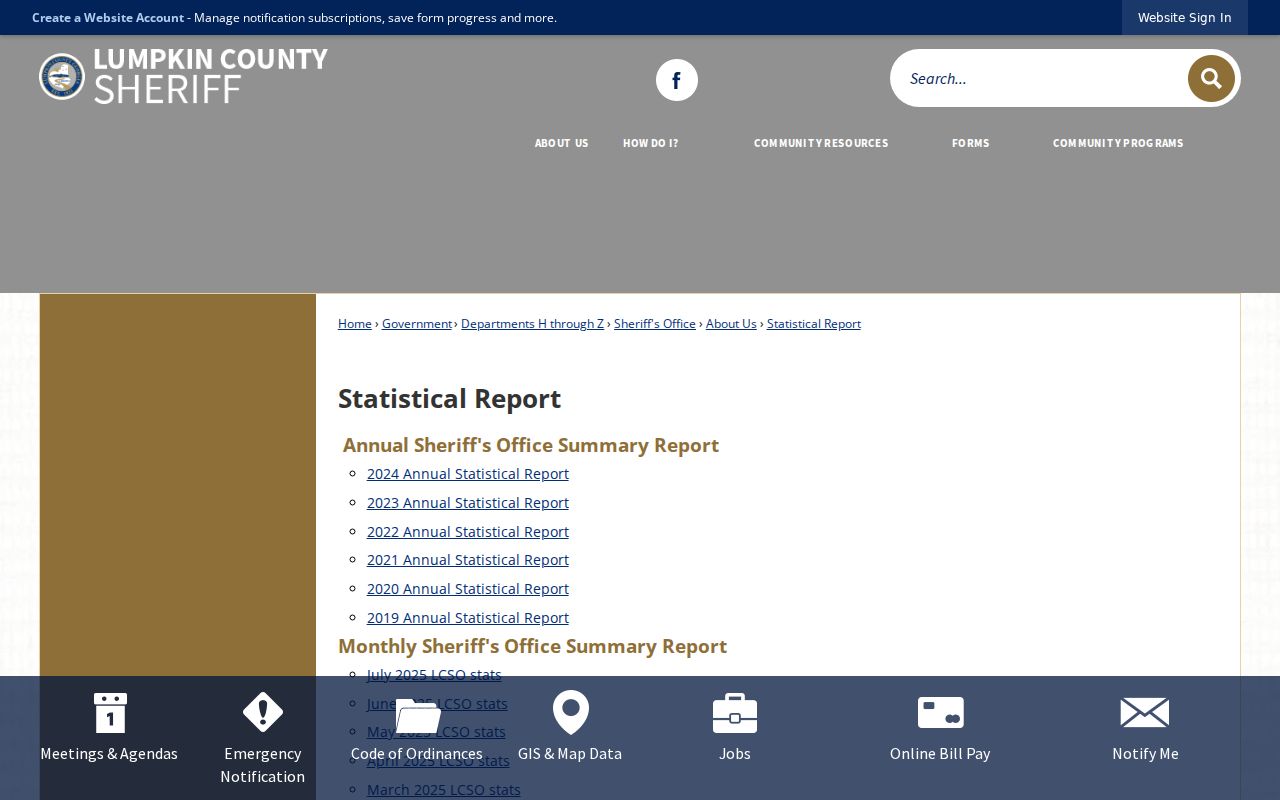
That library holds operational reports, not a live outstanding-warrant list. Calling the 507 events 507 active warrants would turn a Lumpkin County workload code into a false case count.
Warrant Roundups and Most-Wanted Lists
Lumpkin County runs no Most Wanted program, warrant roundup, amnesty calendar, or reward schedule. No partner list or public roster exists either. That gap should not be filled with names pulled from an inmate page. It also does not mean the Sheriff will never announce an initiative, so watch official channels for current notices.
Key Point: The official Sheriff FAQ publishes the crime-tip line, but no Most Wanted roster.
The tip line at 706-482-2699 is for crime information. It is not a personal status service, and callers should never approach anyone.
Where a Most Wanted page exists, it is a selected public-safety message, not every active order. Editorial choices set it apart from a status database. So do the tip instructions. Any Lumpkin County notice belongs on the official source, and tips should go there too.
Requesting Lumpkin County Warrant Records
Two requests live here. One asks whether a warrant is active right now; the other asks for copies of paperwork. The Lumpkin County Open Records page puts "Warrants" on its Sheriff record keyword list and routes Sheriff requests through a separate form, while court records belong with the proper clerk. When you ask the Sheriff for material, be specific: name the warrant application, warrant, affidavit, return, service record, status entry, policy, or log you want, plus a date range and any known number. Vague requests stall.
- Ask for existing, releasable records rather than a new countywide name list.
- Identify the likely agency, record type, date range, and case or warrant number.
- Ask the office to name the custodian if the file belongs to a court.
- Set a fee limit and seek an estimate before work exceeds it.
- Ask for the legal basis for withholding, then confirm live status separately.
Expect a reply, not instant documents. The form says notice generally comes within three business days when records are available, and that timing comes from the Georgia Open Records Act rather than a promise of production. Costs for search, retrieval, redaction, supply, and copies may apply, though the local notice says the first fifteen minutes are not charged. The directory lists the Lumpkin County Open Records Specialist at 706-482-2634. Official pages show two versions of the specialist's email, so confirm routing through the form or by phone instead.
Lumpkin County Status Can Change
An old Lumpkin County warrant record can be genuine and still not tell you whether the order stands today. Service, a recall, an appearance, a file transfer, or a new entry can change which office holds the answer. A current record may exist even with nothing online. So pin down status as of a stated date, and note which office gave it.
- Active or outstanding
- An order the responsible office confirms has not been served, recalled, vacated, or closed.
- Return
- A filing or report about execution or the result of a warrant.
- Recall or vacate
- Court action changing an order; Lumpkin County publishes no universal recall form.
- Failure to appear
- A missed court date that may lead to a bench warrant or other action.
- Capias
- A custody-order term that may appear in Georgia records; ask the clerk for its local meaning.
Some Lumpkin County material stays closed. Search-warrant records can be restricted before execution and return under O.C.G.A. § 17-5-22, juvenile records carry added limits, and protected details may be redacted. A withheld record means only that access is limited by that rule.
When Your Name Is on the Warrant List
With no public list in Lumpkin County, the moment that matters is official confirmation from the Sheriff or the court. Write down the issuing court, the case or warrant number, the order type, the issue date, the status, and the office that answered. Then ask the issuing court or your counsel what applies. A Sheriff can walk you through service or custody routing, but the court alone controls dates, recall, bond, payment, and appearance requirements. Paths from there might include a planned voluntary surrender, posting a court-confirmed bond, appearing as directed, or having counsel ask whether a motion to recall, vacate, or quash is on the table. None of those routes is guaranteed. Lumpkin County publishes no universal surrender appointment, no bond schedule, no clearance counter, and no recall form. And payment by itself may not clear an order.
Important: Speak with an attorney and issuing court before appearing; an active warrant may lead to custody during law-enforcement contact.
If a Lumpkin County entry is wrong or stale, go to the agency that maintains the status and ask for a correction. Request written proof of any recall or release, and ask where it must be sent. The Lumpkin County warrant records overview shows how the Sheriff, the courts, and the resolution routes fit together.