
Lumpkin County Bench Warrants Explained
“Bench warrant” is a handy search term. It means an order issued from the bench. The underlying event might be a missed date, an unpaid obligation, or a failure to comply, and the exact trigger depends on that court and that case. Lumpkin County publishes no separate local definition or universal issuance rule. The court's own wording controls. A clerk may call the entry a bench warrant, a failure-to-appear order, a capias, or something else in the case system. Lumpkin County has no settled standard term. “Capias” cannot be assumed to be the local label. Ask what the docket actually says instead of translating every FTA into a word the court never used.
No Lumpkin Bench-Warrant Roster
The Lumpkin County Sheriff's Office posts no public bench-warrant roster, lookup box, warrant-unit page, update schedule, correction procedure, or warrant-status phone line. Its Sheriff's Office page offers none. That gap does not mean no warrant exists.
Key Point: A missing online name is not a status result; contact the issuing clerk and Sheriff through their official channels.
Georgia keeps no public statewide warrant database. Georgia Courts points existing-warrant questions to the local sheriff, and GCIC and NCIC serve law enforcement only, not the public, so they cannot answer a Lumpkin County warrant lookup.
How Lumpkin Bench Warrants Are Issued
A bench warrant comes from a judge. It issues inside an existing court matter. That differs from Lumpkin County's citizen arrest-warrant application, which involves a sworn application, notice, evidence, possible mediation, and a probable-cause hearing. That route begins a different process entirely. It does not clear a bench order. After the judge directs the warrant, the clerk records the court action and law enforcement may receive it for service. The Sheriff may hold service or custody records. The Sheriff should not be assumed to recall an order issued by a judge, though. Only the issuing court can explain whether a reset, appearance, payment, motion, bond, or some other step applies to a Lumpkin County bench warrant.
Lumpkin Justice Center Rooms
Two public counters share 325 Riley Road in Dahlonega. Magistrate Court sits in Room 109. It lists 706-864-7760 for criminal matters, while the Clerk of Superior Court is Room 108 at 706-864-3736 for Superior criminal files. The Magistrate Court page also posts its public hours.
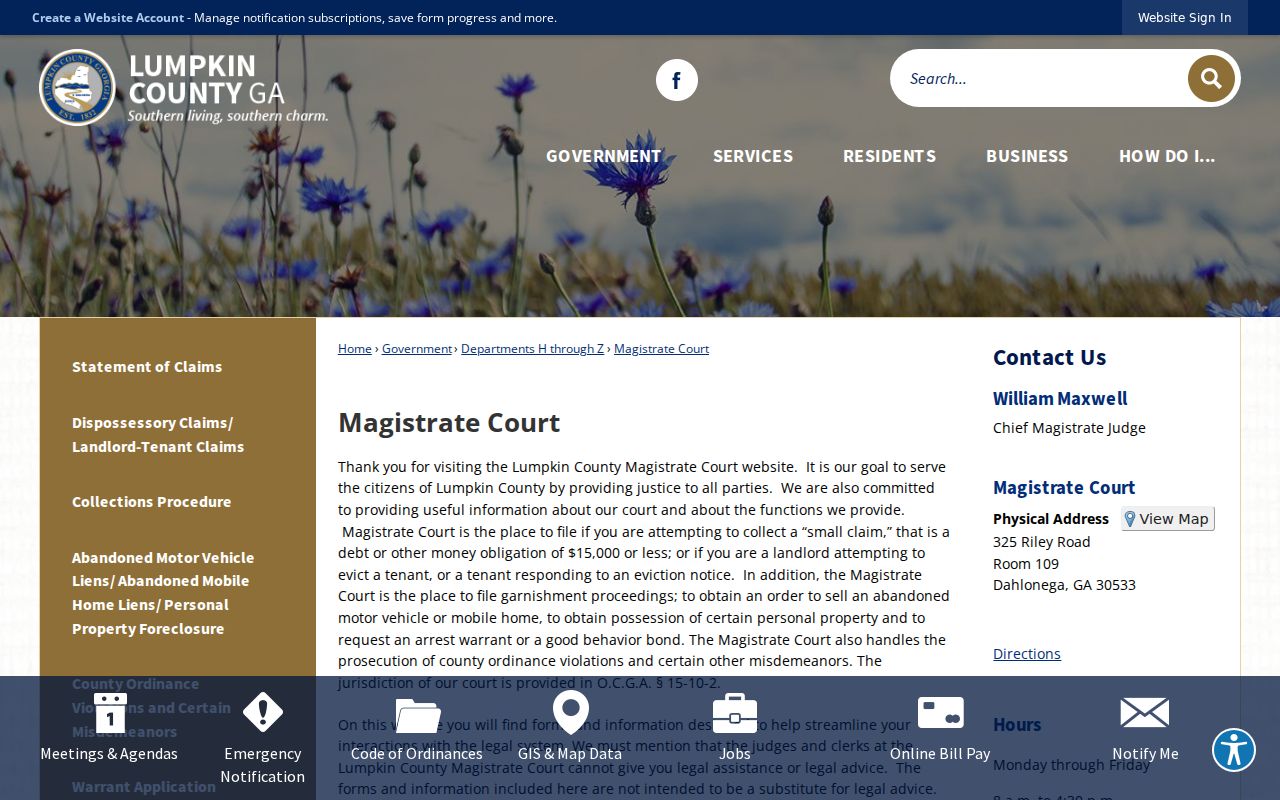
Picking the right room matters. A lower-court warrant can later tie into a Superior case after transfer, so call ahead and ask which Lumpkin County clerk holds the current file.
Bench Warrants and Arrest Warrants Compared
Both orders can put a person in custody. A Lumpkin County bench warrant and an arrest warrant simply arise through different procedural paths.
| Feature | Bench warrant | Arrest warrant |
|---|---|---|
| Typical setting | Existing case or court obligation | Probable-cause application or investigation |
| Common trigger | Missed date or failure to comply | Sworn showing of probable cause |
| Issuing authority | Judge handling the court matter | Authorized judicial officer |
| Resolution source | Issuing court | Issuing court, counsel, and serving agency |
A summons or citation normally just asks for a response. It does not authorize arrest on its own, though ignoring it may bring later court action, and the Lumpkin County clerk must confirm what actually occurred.
Dahlonega's Monthly FTA Trail
Dahlonega Municipal Court, in Lumpkin County, meets monthly. It handles city traffic, ordinance, and general misdemeanor cases. The court lists Clerk Shana Higman at 706-482-2720 and Deputy Clerk Nicole Smith-Easley at 706-482-2701. Its calendar is not a warrant roster. For eligible non-mandatory citations, paying ahead counts as a guilty plea. Not-guilty and no-contest pleas require an appearance. If a license was suspended for failure to appear, the city sends the person to pay at the clerk's office, get a new date, obtain DPS912, and submit the release to DDS. Paying alone does not clear the license or recall a Lumpkin County bench warrant.
Finding the Court That Issued the Warrant
Start from any citation, notice, docket number, or prior court date, then match it to the Lumpkin County office that holds the record.
| Magistrate Court | Room 109; criminal matters and arrest-warrant applications; 706-864-7760. |
|---|---|
| Superior Court Clerk | Room 108; Superior criminal files and transferred records; 706-864-3736. |
| Dahlonega Municipal Court | City traffic, ordinance, misdemeanor, and FTA questions; 706-482-2720. |
| Probate Court | County traffic citations and mandatory-appearance guidance; 706-864-3847. |
| Sheriff | Status routing, service, custody, and Sheriff-held records; 706-864-0414. |
Federal orders belong to the Northern District of Georgia, not a county bench-warrant check.
The Issuing Court Controls Recall
A clerk confirms the entry and routes questions. The judge controls judicial action. The Sheriff cannot be assumed to cancel a court-issued warrant. Court staff cannot give legal advice either. Ask whether the order is active, served, recalled, transferred, or pending, and get the case number, issue date, order label, and required next step. Then ask which office handles a written recall, motion, bond, payment, or appearance. No single answer fits every Lumpkin County court. Note: Status confirmation and legal strategy are separate tasks; an attorney can advise on risk and the right filing for a Lumpkin County case.
Resolving a Lumpkin County Bench Warrant
Lumpkin County offers no same-day recall promise, walk-in clearance counter, self-surrender appointment, amnesty program, or bench-warrant form. Follow only the issuing court's instructions.
- Identify the court, case number, missed setting, and exact order.
- Call the clerk and ask for current status and lawful next steps.
- Consult counsel before appearing when custody may occur.
- Follow the court's payment, reset, motion, bond, or appearance instructions.
- Ask for written proof of recall or a new date, then confirm the status again.
Warning: An in-person Sheriff inquiry may result in custody when a warrant exists; ask about risk and instructions before arriving.
The $45 Fee Is Not Recall
Lumpkin County Magistrate Court publishes a $20 filing fee plus a $25 Sheriff service fee for one defendant in a new pre-warrant application, and a 4.5 percent card charge applies. That $45 total belongs to an applicant. It is not a recall fee, bond, fine, or price for clearing an existing bench order. Dahlonega also lists a $50 appointed-attorney application fee, which is not a bond amount, and no local bench-warrant bond schedule or fixed clearance price exists. Confirm amounts with the court or jail first.
Lumpkin Bench-Warrant Record Requests
Lumpkin County splits its records request system in two. The county Open Records page sends anything the Sheriff holds to a separate Sheriff form, while court files go to the proper clerk. Ask for documents that actually exist. An order, a warrant, a return, a service record, or a docket entry all qualify. Add a date range and any case number you know, since a vague ask gets bounced between offices. Keep in mind what a copy can tell you. A historical warrant file shows what happened then, not what is active now. Georgia's records rules never force an agency to build a fresh live-status report. Fees, redaction, and exemptions can apply, and juvenile files carry extra limits. If Lumpkin County withholds something, ask which legal basis applies. Originals also move around: a warrant can travel with a trial-court file, which is why Magistrate, Sheriff, and Superior records may each hold one piece of the same matter. So request current status and historical copies as separate items, with a narrow date range and an exact record type for each. A precise request lands in the right office faster and keeps court history, service history, and today's warrant status distinct.