
Lumpkin County Arrest Warrants Explained
An arrest warrant gives law enforcement the power to take someone into custody. Georgia warrant law lets a judicial officer issue one when facts sworn under oath add up to probable cause. In Lumpkin County, that work belongs first to Lumpkin Magistrate Court, which takes warrant applications and issues warrants directly. Other judicial officers around the state can do the same within their own jurisdictions. Where the paper ends up depends on the court, the type of case, and how far along it is, so status questions go to the office holding that piece of the file.
Lumpkin's Probable-Cause Sequence
Not every warrant starts with an officer. The county's warrant application process lays out a route a private citizen can take in Lumpkin County. The applicant describes the alleged conduct, reports it to the Sheriff as instructed, and files a sworn application. Witnesses and evidence may follow. The other side usually gets notice, a hearing may be set, and mediation sometimes comes first. If the judge finds probable cause, an arrest warrant can issue. From there the county describes arrest, booking, first appearance, bond, possible conditions, and later review by prosecutors. Keep in mind this is one path, not legal advice, and most law-enforcement warrants never begin with a private application.
Inside a Lumpkin County Arrest Warrant
A releasable Lumpkin County warrant file can hold several parts, each created at a different stage of the case. Access rules vary by piece. A blank field or an old entry is not current status, so confirm with the office that holds the record.
| Application or complaint | The sworn basis presented to the judicial officer. |
|---|---|
| Issuing authority | The court or officer who approved the order. |
| Warrant or case number | A locator such as number assigned by the court; no local public format is documented. |
| Issue date and allegation | The date and cited offense, subject to release restrictions. |
| Service or return | Execution information maintained by the serving agency or filed with the court. |
| Bond and conditions | Case-specific terms requiring current confirmation; no local public schedule was found. |
A Lumpkin County warrant shows the arrest order itself. It will not state the final disposition unless later case records have been joined to the file.
Lumpkin Warrant Application Evidence
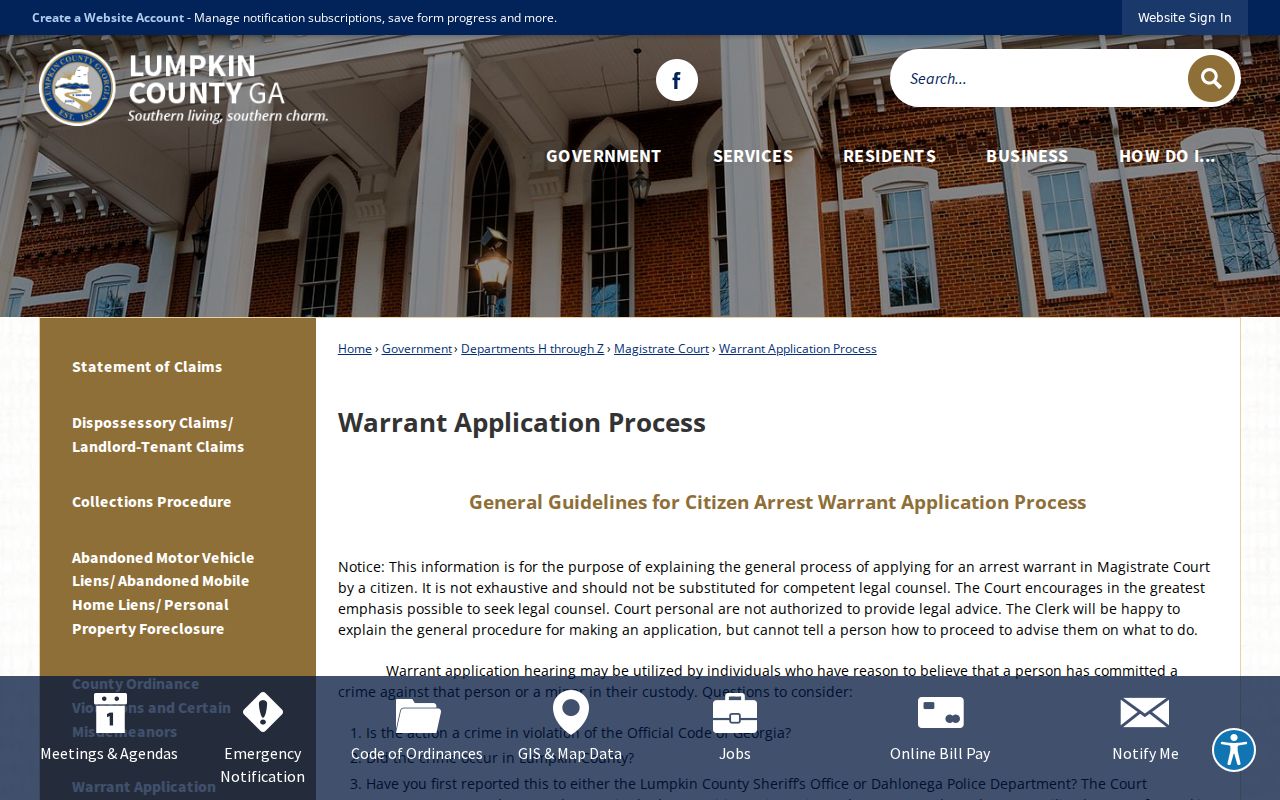
The value of Lumpkin County's process is that it separates an allegation, judicial review, and any later criminal case into distinct stages. It also warns that the judge cannot discuss a matter privately and that court staff cannot give legal advice. The official Lumpkin County warrant application page documents each local application step.
What Lumpkin County publishes is the process, not a conclusion about anyone. Names, affidavits, and case narratives from private applications stay out of public reference material.
Serving Arrest Warrants in Lumpkin County
The Lumpkin County Sheriff's Office is the county's central law-enforcement contact. It publishes its address as 385 East Main Street in Dahlonega and its number as 706-864-0414, with non-emergency dispatch at 706-864-3633. The office offers no warrant-status phone line, portal, or public list. In Dahlonega itself, police job material lists serving warrants and apprehending people on court orders among city officer duties, though that supports a service role, not a public city database. The Sheriff directory also includes Court Services, but its civil-process contacts are not a criminal warrant line. Issuing and serving are different jobs. The court authorizes the arrest; an agency locates, serves, books, and records a return. An agency record can show service without showing the disposition, and a court docket can show an order without each detail in the agency's working file.
Checking Without a Search Box
Lumpkin County publishes no public arrest-warrant search box. Georgia Courts directs people to the local sheriff precisely because no single statewide warrant search exists. A complete local check works through the channels that hold each record.
- Call the Sheriff at 706-864-0414 or non-emergency dispatch for status routing.
- For a Magistrate matter, call the criminal clerk at 706-864-7760.
- For a Superior criminal file, call the Clerk of Superior Court at 706-864-3736.
- For a Dahlonega city matter, call Municipal Court at 706-482-2720.
- Request Sheriff-held documents through the Sheriff Open Records form and court-held documents from the issuing clerk.
Ask for current status and historical copies separately. A Lumpkin County records production can be accurate for its own date yet miss a later arrest, recall, transfer, or disposition.
Arrest Warrants and Court Summonses
The legal effect and origin matter more than the label alone.
| Instrument | How it arises | Immediate function |
|---|---|---|
| Arrest warrant | Probable cause shown under oath | Authorizes custody |
| Summons or citation | Court or officer directs response | Orders appearance without the same initial arrest authority |
| Bench warrant | Judge acts in an existing matter | May authorize custody after a missed obligation |
A missed summons can trigger later court action in Lumpkin County, but not every citation is an arrest warrant. The issuing clerk can identify the actual entry on the docket.
Lumpkin Warrant Files Can Move
Warrant files in Lumpkin County do not sit still. Georgia Courts' magistrate-clerk material gives arrest and search warrant files a ten-year retention period, covering applications, affidavits, and evidence. An original arrest warrant can also be bound over to the trial court along with the case file. That handoff is why the Sheriff, Magistrate Court, and Superior Court Clerk may each hold a different piece of the same matter. A service record may rest with law enforcement while the original warrant and later disposition sit in court files. Ask every relevant office rather than assuming one custodian owns the whole lifecycle.
If There's an Arrest Warrant for You
Do not plan around a name search, an inmate page, or an old document. Get current information and legal advice first. Georgia's official guidance warns that walking into a Lumpkin County Sheriff's inquiry in person could lead to custody if a warrant exists.
- Identify the issuing court, warrant type, case number, and current status.
- Consult an attorney about surrender, bond, and court procedure.
- Ask the court or serving agency for lawful appearance or surrender instructions.
- Bring only the identification and documents requested.
- After action is taken, request written proof and confirm the docket and agency status.
Important: Lumpkin County offers no same-day recall, self-surrender appointment, walk-in clearance counter, or universal bond process.
Lumpkin NCIC Results Are Referrals
The Lumpkin County criminal-history form includes office-only boxes for a no NCIC or GCIC result and for a possible warrant result, and it tells the operator to contact the listed agency. Those boxes mark an internal referral, not a public warrant search or a final statement of court status. GCIC and NCIC are criminal-information systems for authorized users. A criminal-history request carries its own identification, fee, and eligibility rules. It is not a guaranteed sweep of every county, municipal, state, or federal arrest warrant.
Lumpkin Arrest-Warrant Access Rules
In Lumpkin County, anyone asking for warrant paperwork starts with the county Open Records page, which lists warrants among Sheriff records and points to a separate Sheriff form. Court records go through the clerk instead. A focused request works best. Name the item you want, whether that is an application, affidavit, warrant, return, service record, or docket entry, and add a date range plus any known number. Georgia's Open Records Act does not force an agency to build a new live warrant report. Fees, redactions, exemptions, and timing can all apply. Juvenile materials carry their own access limits. Search-warrant files have confidentiality rules of their own, so don't assume they extend to every arrest warrant; a narrow request helps the right office find the right record in Lumpkin County.
Access rule: Ask the withholding office for the statutory basis, and verify any produced historical record against current court status.